Fast-Moving Consumer Goods (FMCG) companies operate in an environment where speed, efficiency, and consistency are not just goals—they are imperatives. From high-speed packaging lines to precision processing equipment, the machinery within FMCG production facilities serves as the lifeblood of the business. Even a brief interruption can ripple through supply chains, erode profit margins, and damage customer trust. In this extended exploration, we’ll dive deeper into the critical machines that power FMCG operations, examine the root causes of unexpected failures, and outline best practices for minimizing unplanned downtime and maintaining seamless production.
The Pivotal Role of Machinery in FMCG Operations
In the FMCG industry, volumes can range from tens of thousands to millions of units each day. Behind every bottled beverage, bar of soap, and packaged snack lies a complex orchestration of automated systems working in concert. Key categories of equipment include:
- Processing Equipment: Machines such as industrial mixers, pasteurizers, homogenizers, and blenders handle raw materials—mixing ingredients, applying heat treatments, or performing chemical processes essential for product safety and quality.
- Filling and Dosing Systems: Precision dispensers measure and dispense liquids, powders, and semi-solids into containers, ensuring that every unit meets exact specifications for volume, weight, and consistency.
- Packaging Machinery: High-speed wrappers, sealers, cartoners, and case packers form the outward shell, applying labels, barcodes, and protective films. These systems often run at speeds exceeding hundreds of packs per minute.
- Conveyors and Robotics: Automated conveyors, robotic pick-and-place arms, and automated guided vehicles (AGVs) transport materials between stations, connecting processing, inspection, and packaging phases with minimal human intervention.
- Quality Inspection Systems: Vision-based cameras, metal detectors, X-ray scanners, and weighing scales verify product integrity and compliance with regulatory standards, catching defects before they leave the factory.
- Support Utilities: Compressors, chillers, boilers, and water treatment plants form the backbone of facility infrastructure, supplying the temperature, pressure, and purity levels required for critical processes.
Each of these machines is a specialized component in a larger ecosystem. A malfunction in any one element can lead to cascading problems, from initial quality deviations to full-line stoppages.
Defining “Critical” Machines
Not all equipment carries equal weight in production. A critical machine is one whose failure directly threatens the plant’s output, product quality, or compliance status. These machines share several characteristics:
- High Utilization Rate: They run continuously, often near design capacity, leaving little room for unscheduled repair windows.
- Single-Point-of-Failure: There is no quick alternate path; work cannot bypass or parallel the equipment without significant reconfiguration.
- Long Lead Times for Parts or Repairs: Specialty components may require weeks to procure, and skilled technicians may be necessary for complex overhauls.
- Regulatory or Safety Impact: A breakdown could risk product recalls, regulatory fines, or endanger workers if safety interlocks fail.
For example, a bottling filler in a beverage plant is typically one of the highest-speed, hardest-working machines on the floor. If it stalls, the entire downstream packaging line grinds to a halt. Similarly, a pasteurizer in a dairy plant represents a compliance-critical step—its failure risks spoilage, off-spec products, and potential health hazards.
Common Root Causes of Machinery Breakdowns
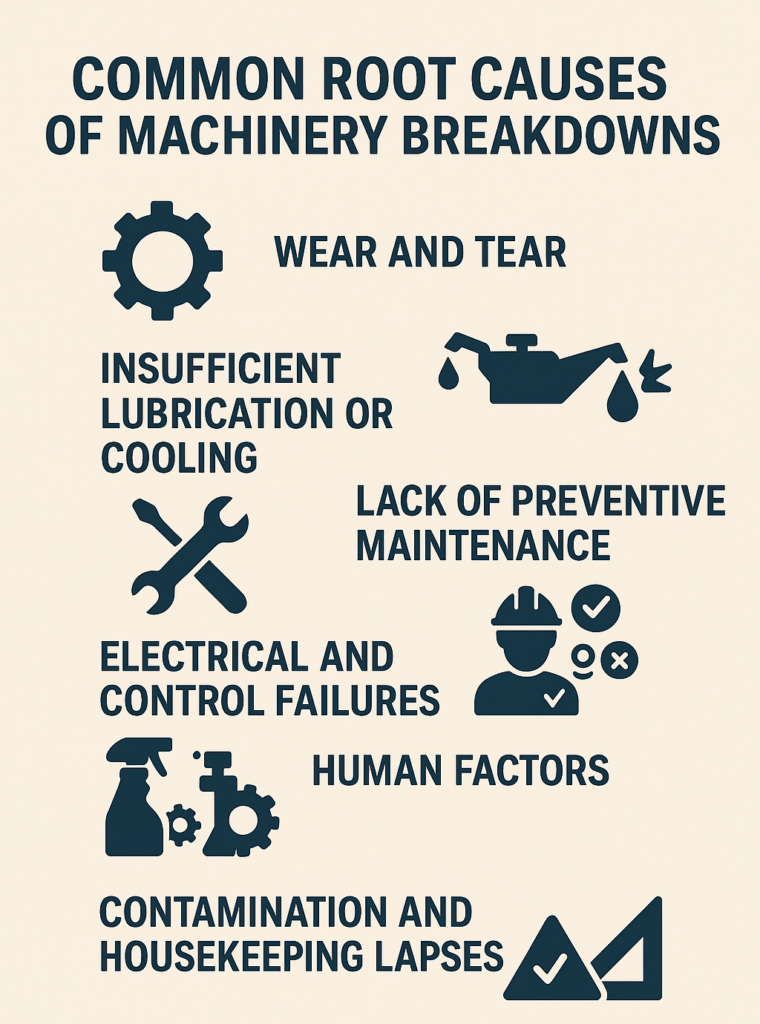
By understanding why machines fail, FMCG operators can shift from reactive firefighting to proactive prevention. Common failure drivers include:
- Wear and Tear: Continuous operation leads to bearing wear, seal degradation, and abrasion of moving parts. Over time, clearances widen, vibrations increase, and thermal stresses accumulate.
- Insufficient Lubrication or Cooling: Missed or improper oil changes, clogged lubrication lines, or compromised cooling circuits accelerate component fatigue and lead to overheating.
- Lack of Preventive Maintenance: Many failures stem from small issues—loose bolts, belt misalignment, or minor leaks—that escalate when undetected. A structured preventive maintenance program catches these anomalies early.
- Electrical and Control Failures: Voltage spikes, faulty sensors, deteriorating cables, and PLC software bugs can trigger sudden stops or erratic behaviour in servo motors and drives.
- Human Factors: Operator error—such as incorrect setup, overloading, or bypassing safety protocols—can physically damage equipment and void warranties.
- Contamination and Housekeeping Lapses: In food and beverage plants, product residue, dust, moisture, and corrosive cleaning agents can infiltrate bearings,gearboxes, and electronic enclosures.
Quantifying the True Cost of Downtime
While the headline number might be the lost output—say, 5,000 bottles per hour at a filling line—the cascading costs go far deeper:
- Lost Production Volume: Every minute of downtime translates into fewer units available for shipment, potentially triggering stockouts and expedited freight costs.
- Spoilage and Rework: Temperature-sensitive or batch-processed goods may require disposal or repackaging if production halts mid-run.
- Labour Inefficiency: Operators and quality teams idle or engage in clean-up, reducing overall throughput and adding to labor costs.
- Unplanned Overtime: Shrink-wrapped production schedules often force shifts or weekend work to regain lost ground, inflating labor budgets.
- Maintenance Premiums: Emergency repairs with outside contractors’ command higher hourly rates and rush shipping fees.
- Customer and Brand Impact: Chronic reliability issues can erode customer confidence, leading to lost contracts or shelf space.
Industry benchmarks suggest that unplanned downtime in FMCG plants can exceed 5–10% of total scheduled operating hours, translating to millions in annual lost revenue for large facilities.
Proactive Strategies to Minimize Breakdowns
A comprehensive reliability program blends people, processes, and technology:
- Predictive Maintenance with IoT Sensors: Deploy vibration, temperature, and acoustic sensors on critical bearings and motors. Platforms analyze trends and alert when readings deviate from established baselines, enabling targeted interventions before failure.
👉 Explore how MachineAstro’s Predictive Maintenance Solution helps FMCG plants reduce unplanned downtime.
- Digital Twin and Simulation: Model critical machines in software to simulate operating conditions, test maintenance scenarios, and optimize spare parts stocking strategies.
- Spare Parts Management: Implement a tiered inventory policy—maintain fast-moving, failure-prone parts locally while using vendor-managed consignment for less frequent items.
- Structured Operator Training: Develop certification programs to ensure consistent machine setup, safe operation, and empowered frontline personnel who can recognize early warning signs and perform basic inspections.
- Root Cause Analysis (RCA): After any significant event, conduct a formal RCA workshop (e.g., Five Whys, Fishbone diagram) to identify systemic issues and prevent recurrence.
- Digital Maintenance Records: Use a centralized CMMS (Computerized Maintenance Management System) to track work orders, parts history, and labor hours—enabling data-driven continuous improvement.
- Redundancy and Parallelization: For machinery that represents a single point of failure, consider installing parallel units or flexible changeover systems that can maintain throughput during maintenance.
- Cross-Functional Reliability Teams: Form multidisciplinary teams that include engineering, operations, quality, and procurement to align on maintenance priorities and investment decisions.
Conclusion: Building a Culture of Reliability
In today’s fast-paced FMCG landscape, the agility and resilience of production operations hinge on machine reliability. Critical assets—whether they are mixers, fillers, or high-speed packers—must receive focused attention. While unexpected breakdowns can never be eliminated entirely, an integrated strategy that combines advanced condition monitoring, robust maintenance processes, and empowered personnel can dramatically reduce unplanned stoppages.
By mapping out the critical machines in your facility, understanding their specific failure modes, and investing in predictive technologies, FMCG companies can keep their production lines humming at full capacity. The result is not only improved financial performance but also a stronger competitive position and greater confidence among customers and partners. After all, in the world of fast-moving consumer goods, every minute of uptime counts.
Learn more about how MachineAstro supports FMCG manufacturers with AI-based predictive maintenance, energy analytics, and edge IoT solutions.
🔗 Follow us on LinkedIn for the latest updates and insights.
📧 Contact Us: sales@machineastro.com