Introduction
Steel manufacturing plants are some of the toughest industrial workplaces in the world. They run around the clock with huge, powerful machines that all work together. In this environment, every hour of machine stoppage can cost thousands—or even millions—of rupees in lost production.
Some machines are more than just equipment; they are the lifelines of the plant. These include descaler pumps, TMT gearboxes, rolling mill drives, cranes, fans, and compressors. Without them, production would come to a standstill.
But here’s the problem—many of these critical machines are still maintained using old-fashioned methods. This usually means:
- Doing maintenance at fixed time intervals (whether it’s needed or not).
- Fixing things only after they break down.
This approach is risky. In a high-pressure industry like steel, guessing when machines might fail is not good enough. Instead, steel plants need to move from time-based maintenance to condition-based, real-time monitoring—a smarter way of working that focuses on the actual health of the machine.
The Challenge: Harsh Conditions and Constant Pressure
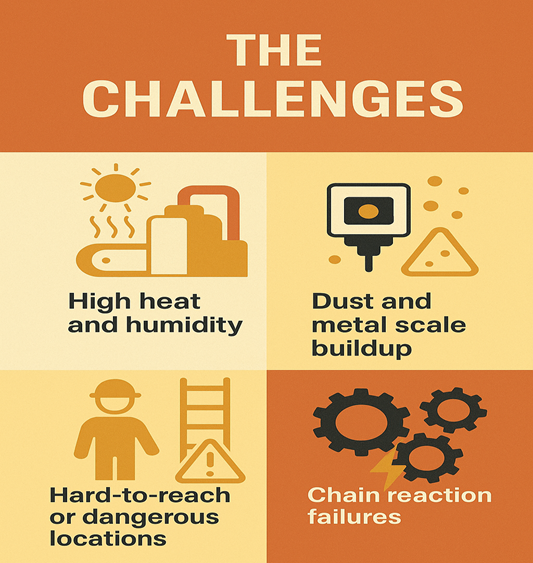
Steel plants face some of the most extreme operating conditions in any industry:
- High heat and humidity speed up wear and tear on parts.
- Dust and metal scale build up, which can block sensors and reduce mechanical efficiency.
- Hard-to-reach or dangerous locations make it risky and difficult to manually inspect some machines.
- Chain reaction failures—if one important machine fails, it can stop an entire production line.
Relying only on periodic visual checks or scheduled maintenance is not enough in such conditions. By the time a problem is visible to the naked eye, the damage is often already done.
Critical Machines and Their Weak Points
Machine | What It Does | Common Problems |
Descaler Pump | Cleans the steel surface before finishing | Bearing faults, cavitation, impeller imbalance |
SMS Cranes | Moves heavy steel between production stages | Misalignment, looseness, gearbox wear |
Cooling Fans | Keeps equipment at the right temperature | Fan imbalance, rotor problems |
Rolling Mill Gearbox | Powers rollers that shape hot steel | Gear tooth wear, lubrication failure |
TMT Gearbox | Shapes high-strength rebar | Overheating, shaft misalignment |
Pellet Motors | Pushes raw material toward the furnace | Vibration spikes, electrical faults |
Every critical machine in a steel plant has its own set of vulnerabilities. Here are a few examples:
If any of these fail unexpectedly, it’s not just a machine problem—it’s a production, safety, and quality problem.
What Can Go Wrong (And Often Does)
Real-world data from steel plants shows patterns in machine failures:
- Repeated bearing failures in descaler pump and fan motors.
- Vibration signals showing BPFO (Ball Pass Frequency Outer) and BPFI (Ball Pass Frequency Inner) faults—both signs of bearing raceway damage.
- High vibration levels at low frequencies, which suggest looseness or imbalance.
- Lubrication issues—either too much or too little oil—causing overheating and gear damage.
These problems don’t just appear suddenly. They build up over days or weeks. Without real-time monitoring, these early warning signs go unnoticed until it’s too late, leading to expensive breakdowns.
From Reactive to Predictive: A Better Way
To break free from this “fix it after it fails” cycle, steel plants are turning to Condition-Based Monitoring (CBM) powered by IoT sensors and Artificial Intelligence.
Here’s how it works:
- Vibration Sensors
Special tri-axial sensors are mounted on motors, pumps, gearboxes, and fans. They continuously record vibrations in three directions—horizontal, vertical, and axial. This data helps detect issues early.
- Signal Analysis (FFT)
The system uses Fast Fourier Transform (FFT) to break vibration data into frequency components. This helps spot patterns linked to specific faults:
- Imbalance → 1X RPM frequency
- Misalignment → 2X RPM frequency
- Bearing faults → Higher harmonic frequencies
- AI-Powered Diagnostics
Cloud-based platforms like MachineAstro’s iEdge360 analyze sensor data in real time. The AI models:
- Identify early warning signs
- Show how severe the problem is
- Recommend actions for maintenance teams
This means engineers get alerts weeks before a failure could happen—turning crisis management into planned action.
Why Condition-Based Monitoring Works
Shifting to CBM has big benefits:
- Maintenance Only When Needed – Stop over-servicing machines that are fine or waiting too long until they fail.
- Planned vs. Unplanned Downtime – Fix issues during scheduled shutdowns instead of disrupting production mid-shift.
- Longer Machine Life – Prevent small issues from turning into big, costly failures.
- Lower Energy Waste – Healthy machines run more efficiently and consume less power.
- Better Safety – Fewer risky manual inspections in hazardous areas.
Learn more about how MachineAstro delivers these benefits for steel plants.
Real-World Impact: Data from the Field
In a recent deployment at a steel plant, vibration sensors on a rolling mill gearbox detected early signs of shaft misalignment. The machine was still running, but analytics showed increasing axial vibration beyond acceptable ISO 20816 thresholds. Maintenance was scheduled during planned downtime—preventing a failure that would have halted production for 48+ hours.
In another instance, descaler pump motors showed rising vibration in the horizontal direction. FFT analysis flagged potential outer race bearing wear (BPFO). Replacement was done proactively, reducing potential downtime by over 30 hours.
About MachineAstro
With over 35 years of experience, MachineAstro has established itself as a global leader in providing cutting-edge IoT, AI-driven solutions, and industrial automation systems. Our expertise spans across multiple industries, enabling businesses to harness the power of predictive maintenance, real-time monitoring, and advanced data analytics to optimize their operations.
The Key Takeaway
Steel plants can’t afford to leave their most important machines unchecked. Old maintenance methods simply don’t work in today’s fast-paced and high-pressure environment.
By moving from time-based to real-time, condition-based monitoring, plants can:
- Avoid sudden breakdowns
- Improve uptime and productivity
- Keep workers safe
- Save money on repairs and energy costs
The message is simple—the plant is always telling you how it feels. You just need the right tools to listen.
 How to Analyze Output and Downtime for Steel Slitting Machines February 7, 2026 at 6:53 am[…] happens on your line as it happens. You get alerts when something goes wrong, so you can act fast.